You can get a dependable ring measurement at home with nothing more than a piece of string or a ring you already wear. Here's how to do it well.
Method 1: string and ruler
Wrap a strip of paper or a length of string around the base of the finger. Mark where it overlaps, then measure that length in millimeters against a ruler. That measurement is your finger's circumference, which maps directly to a ring size.
Method 2: measure a ring you own
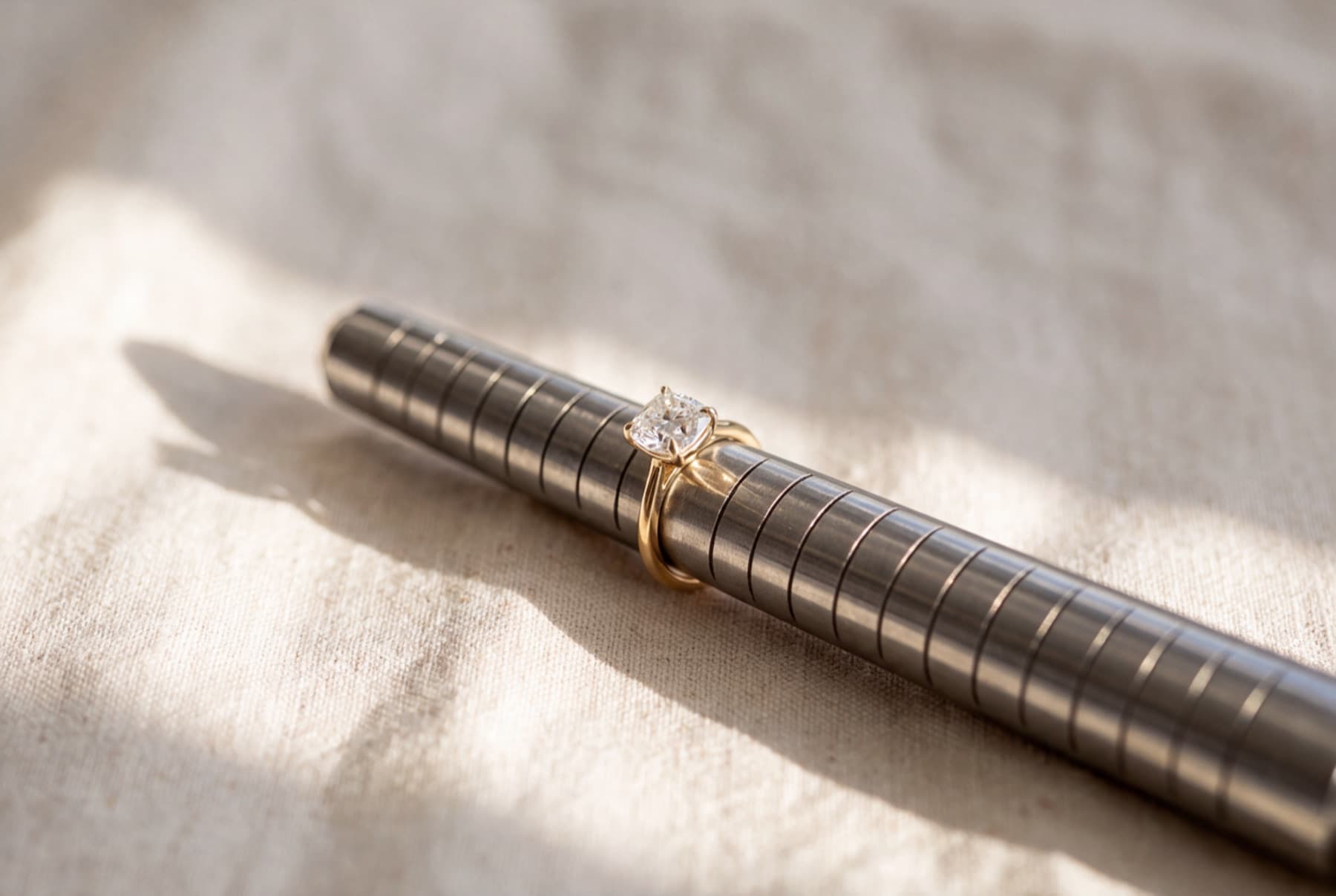
Take a ring that already fits the correct finger and measure the inside diameter across the middle in millimeters. Comparing the diameter to a sizing chart is often the most accurate home method, since it removes any tension in wrapping.
Quarter sizes
The chart lists whole and half sizes, but US rings also come in quarter increments — a 5¼ or a 5¾ — for measurements that fall in between. If your reading sits between two rows, a quarter size is often the truer fit: a circumference near 51.5 mm, for instance, falls between a 5½ and a 6 and corresponds to roughly a US 5¾. European sizing, being the circumference itself, captures these in-between readings directly — 51.5 mm is simply an EU size 51.5.
Tips for accuracy
Measure at the end of the day, when fingers are at their largest, and avoid measuring when cold. Fingers on your dominant hand tend to run slightly larger. If you're between sizes, size up — a ring that's a touch loose is easier to live with than one that won't pass the knuckle. We're happy to resize eligible pieces to fit; some, however, cannot be resized due to their construction, so we'll always confirm what's possible for a given piece.